
Firefighter or Architect? Choosing How You Lead Today.

As leaders, we are often rewarded for how fast we can solve a problem. But speed can be the enemy of excellence. In my last article, we explored how certain habits kill ideas before they have a chance to breathe.
Today, I want to dive into the specific tools that help us build something better.
While there are many ways to approach a challenge, one concept from our recent training has truly captured my attention:
The ideal Outcome Strategy
My Favorite Concept: The Ideal Outcome Strategy thisis a mental shift that moves you from being a firefighter to being an architect. Most people start with constraints the budget, the lack of time, the "why we can't." This strategy demands the opposite. You begin by vividly imagining the situation as if the problem has already been solved in the best possible way.
By ignoring the "how" for a moment and focusing entirely on the "what," you gain a crystal-clear image of your true objective. It saves time because it prevents "solution drift" it ensures that every ounce of energy your team spends is moving you toward the best result, not just the easiest one.
The Key Questions: What would the ideal final outcome look like? How would we know the problem has been truly solved?
Three Additional Strategies for Your Toolkit
To complement the vision of an ideal outcome, we can use these three supporting strategies to move the needle:
1. The Embryo Strategy
Innovation doesn’t always arrive fully formed. Look for a small, incomplete, but promising germ of a solution. It’s about catching a sensible direction that you can later expand and strengthen.
The Key Question: What is the smallest element of a solution that we can already see here?
2. The Strategy of Abundance
This is about quantity over quality initially. Generate the largest possible number of ideas and variants. Don't stop at the first obvious answer; the more ideas you have at the start, the higher the chance of finding a breakthrough.
The Key Question: What else?
3. The Creative Distancing Strategy
When you are too close to a problem, you can’t see the solution. Step away and stop looking at it literally. Use metaphors or analogies to break away from routine thinking and see the issue in a new light.
The Key Questions: This problem is like...? How else can we look at this?
By integrating these strategies and starting with the Ideal Outcome we move from just managing problems to truly leading innovation. Don't settle for "fixed." Aim for "ideal."
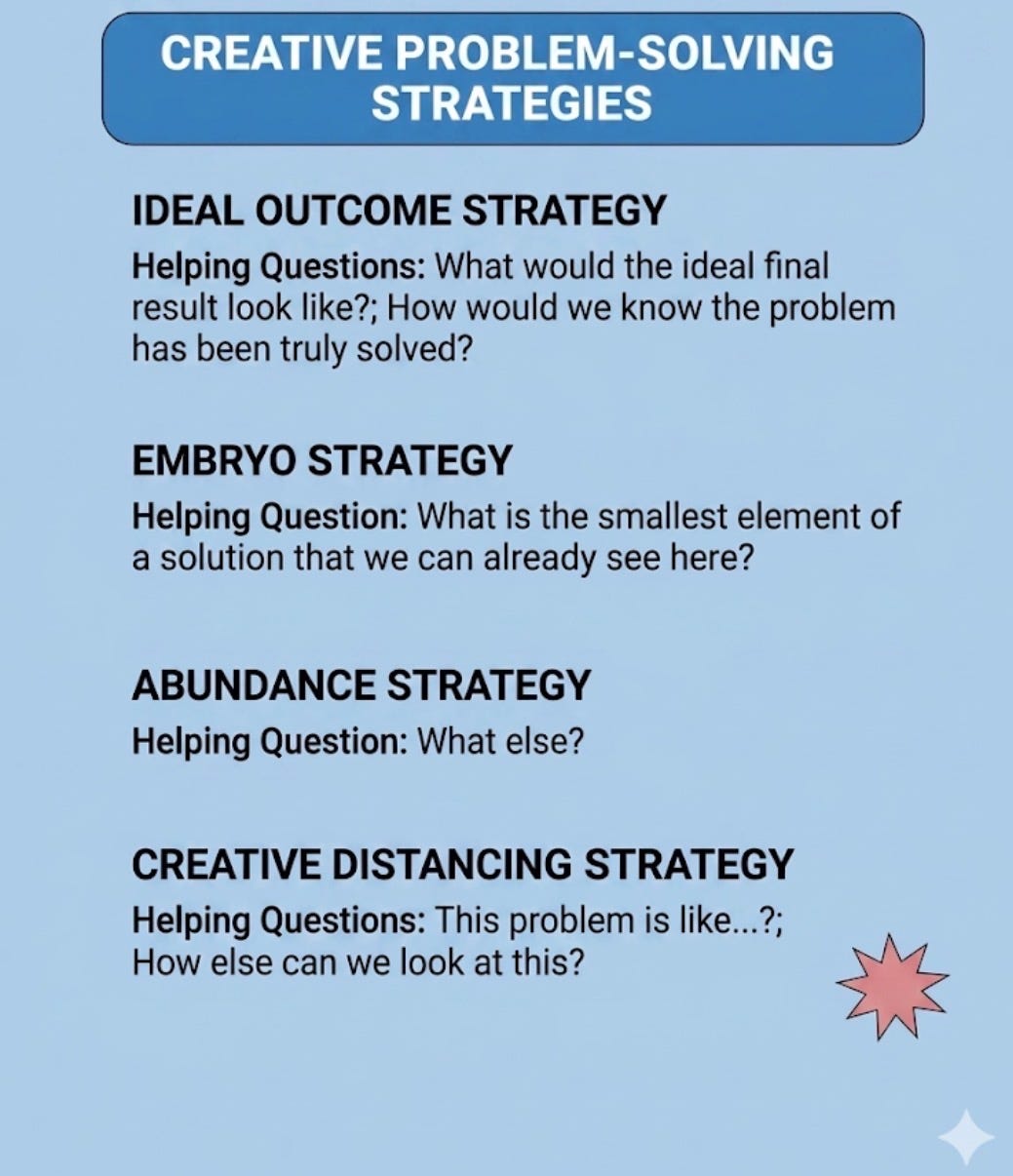
Which of these four strategies will you take with you to your next meeting? I’d love to hear which one feels most like the 'game-changer' for you.
**Inspired by a creativity workshop I attended on April 9, led by Aleksandra Olewniczak, and by works on creativity including:
Nęcka, E., Gruszka, A., Orzechowski, J., & Szymura, B. (2019), *Training Creativity*
Nęcka, E. (2003), *Psychology of Creativity*
Paszkowski, M. (2008), *Discover Creativity Within Yourself*